

Insights from Ashley Sczudlo, AVP Consumer Engagement & Strategy
Introduction
As Rock Health’s 2025 Consumer Adoption Survey recently revealed, one in three Americans now use AI chatbots for health information, a rate that is double that of just a year ago. Consumers are racing ahead, adopting digital health tools on their own terms and arriving at clinical encounters already “AI-informed.” But our research uncovered something even more fundamental: the barrier isn’t adoption at all. It’s fragmentation.
Patients already trust digital health. The challenge isn’t getting them to use technology, but making that technology work together.
We conducted a research study to understand what patients want from their digital health experience, building on insights from the broader consumer AI adoption trends.
What we found challenges conventional wisdom: The healthcare industry is solving the wrong problem.
- The assumption: Patients aren’t ready for digital health due to privacy concerns and resistance to technology.
- The reality: 98% already use patient portals. They’ve overcome their privacy concerns. They’re not technophobic—they’re system-exhausted.
The #1 feature patients want? Immediate access to their complete health history in emergencies—valued by 90% across every demographic. Not convenience, or cost savings, or efficiency. The ability to potentially save their life when seconds matter.
The real barrier isn’t adoption. It’s that fragmented systems don’t talk to each other.
This is the opportunity facing every digital health company right now. Patients want digital solutions. They’re ready for them. As the Rock Health data shows, they’re even experimenting with AI chatbots at unprecedented rates. But they’re shouldering burdens that healthcare can’t manage because of fragmentation—acting as their own medical records courier, repeating information at every visit, and connecting dots between systems that refuse to connect themselves.
In this report, we reveal what patients actually value, why companies that solve fragmentation will dominate the next decade of healthcare innovation, and the strategic moves to get it right.
About This Research
This report is based on a survey of 219 U.S. adults who interacted with healthcare providers in the past 12 months, conducted in Fall 2025 as part of our CMS “Kill the Clipboard” initiative commitment.
Our sample included diverse healthcare utilization patterns:
- 40% low utilizers (0-2 annual visits)
- 44% moderate utilizers (3-5 annual visits)
- 17% high utilizers (6-10+ annual visits)
Methodology: Participants rated their level of agreement with pain point statements (1-5 scale) and the value of potential solutions (1-5 scale). We analyzed patterns across utilization frequency, age groups, and digital tool adoption. Given our sample size, particularly when examining subgroups, we present our findings as directional insights rather than definitive market claims.
The Data That Should Change Your Strategy
We surveyed healthcare consumers as part of our commitment to end “portalitis,” the frustrating burden of managing multiple disconnected patient portals. What we found challenges conventional wisdom about digital health adoption.
The pain is real—and it’s getting worse:
- 62% are frustrated with repetitive intake forms (average pain score: 3.76/5)
- For patients with 10+ annual visits, frustration jumps to 4.3/5—a 19% increase
- 27% feel their doctors don’t have access to their complete health history
But the opportunity is bigger than we thought:
- 98% already use patient portals like MyChart
- 30% use wearable health apps
- 73% believe digital records are more reliable than paper
The insight everyone’s missing:
The healthcare industry keeps trying to solve patient adoption. But adoption isn’t the problem.
Patients aren’t technophobic. They aren’t held back by privacy concerns. The problem is that healthcare forces them to manage multiple disconnected systems.
As one frustrated patient told us: “It would be great if you could have the same portal for all doctors and people in your home for even easier access.”
The market isn’t asking for digital transformation. It’s asking for digital integration.
Privacy Isn’t the Problem You Think It Is
Here’s where it gets interesting.
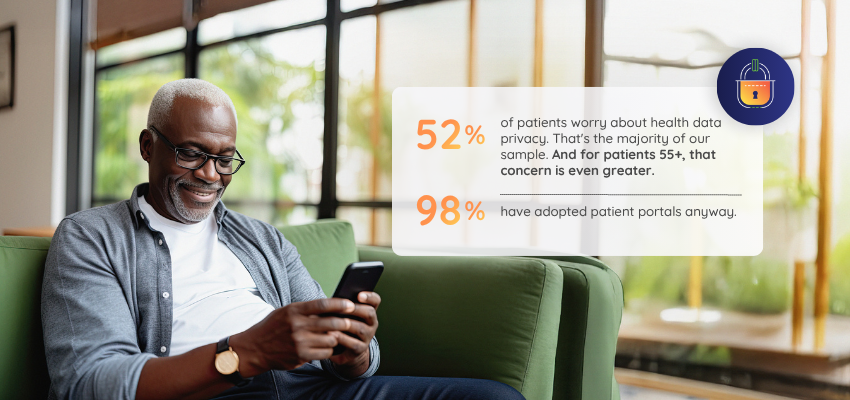
This tells us something critical: Privacy isn’t the barrier we think it is. Patients have already decided that the benefits outweigh their concerns. Privacy is a hygiene factor—it must be addressed to maintain trust, but it’s not preventing adoption.
When we dug deeper, we discovered something surprising:
Patients don’t want to micromanage their data.
We tested the value of granular privacy controls – the ability to choose exactly which parts of their health records to share with each doctor. Many companies are building this feature.
It rated lowest in value of all features tested (3.83/5).
The 55-64 age group with the highest privacy concerns? They valued this feature the least (3.7/5).
Our interpretation suggests that patients don’t want to become their own data security managers. They don’t want to make dozens of individual sharing decisions every time they see a new provider. They want comprehensive security from trusted partners—protection by default, not the burden of constant choices.
The High-Value Segment You Should Target First
Not all patients feel this pain equally. And that’s your strategic advantage.

These are your early adopters.
They’re managing chronic conditions, coordinating multiple specialists, and dealing with complex health needs. Every visit brings another clipboard, another opportunity for information gaps, another reminder that the system is broken.
One high-frequency user rated every single pain point as “Strongly Agree” and every solution as “Extremely Valuable.” This wasn’t an outlier—it’s a pattern.
The Strategy:
Don’t try to serve everyone at once. Design and prove value for high utilizers first. Then expand to the mainstream market (the 44% with 3-5 annual visits) with validated solutions and compelling proof points.
Even low utilizers (the 40% with 0-2 annual visits) see strong value—especially for emergency scenarios. But they won’t be your early adopters. High utilizers will.
Three Critical Moves to Get it Right
1. Lead With Safety and Convenience
Emergency care access rated 4.32/5—higher than any other feature. It resonated universally across every demographic.
This isn’t just about saving 10 minutes at check-in. It’s about potentially saving lives in critical moments.
Frame your value proposition accordingly. Convenience is a benefit. Safety is the reason to adopt.
2. Double Down on Integration
Over 98% of patients already use portals. 30% use wearables. 14% use personal health apps. 12% use pharmacy portals.
They don’t need another login to remember. They need their existing tools to work together, leveraging modern authentication methods like IAL2 facial recognition to remove friction without compromising security.
The opportunity isn’t to replace portals and health apps. It’s to make them work together seamlessly for the first time.
3. Reduce Security Friction
With 52% worried about privacy, trust can’t be an afterthought. But here’s the balance:
Patients need data protection, but they also need systems that don’t make them feel like they’re guarding state secrets. Explain in plain language how their data will be used. Make consent easy to understand and manage. Implement secure yet seamless authentication.
The companies that win will make security feel effortless rather than burdensome, and modern authentication. Clear explanations. Invisible protection.
What’s Next
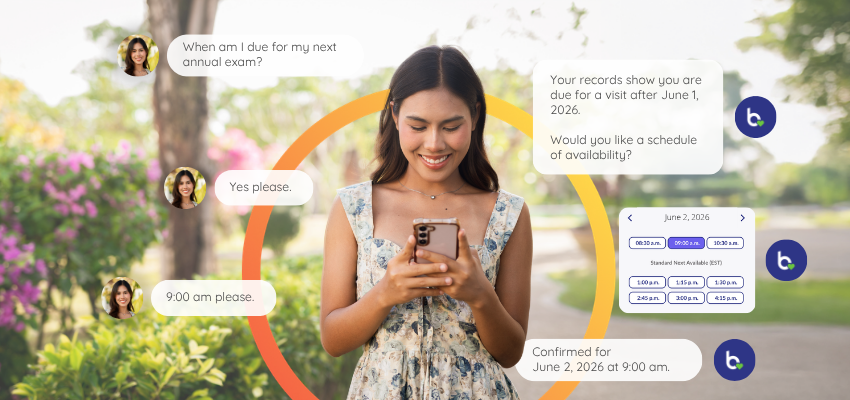
The clipboard is disappearing—the technology to replace it exists, the standards through CMS’s initiative are in place, and consumers are already living digitally.
They’re not waiting for perfect solutions or asking for revolutionary technology. They want systems that work together, protect their data, and respect their time.
As we continue to work with healthcare providers, payers, and other stakeholders, the path forward becomes clear: digital health adoption isn’t a technology problem—it’s a fragmentation problem. And solving fragmentation isn’t built solely on features or functionality. It’s built through understanding what patients truly value, designing solutions that integrate seamlessly into their lives, and delivering security that protects without burdening.
The organizations that embrace these insights won’t just improve patient satisfaction scores. They’ll fundamentally transform how healthcare is delivered, creating experiences that patients choose to actively engage with.
The question isn’t whether digital health will succeed. It’s whether your organization will be among those leading the way.
About b.well Connected Health
b.well Connected Health is the most data-rich digital health platform for AI-powered consumer experiences, personalized care, and better outcomes. The company solves healthcare’s fragmentation problem with a scalable, FHIR®-based platform that unifies health data, solutions, and services in one place. By creating longitudinal health records, cleansing and standardizing fragmented data through its proprietary Data Refinery, and delivering proactive insights, b.well empowers organizations to engage consumers in real time, simplify access to care, and support regulatory compliance.
Visit icanbwell.com to connect with one of our solution experts: https://www.bwell.com/lets-connect/
About This Research
Survey of U.S. adults who interacted with healthcare providers in the past 12 months, conducted Fall 2025 as part of our CMS “Kill the Clipboard” initiative commitment.